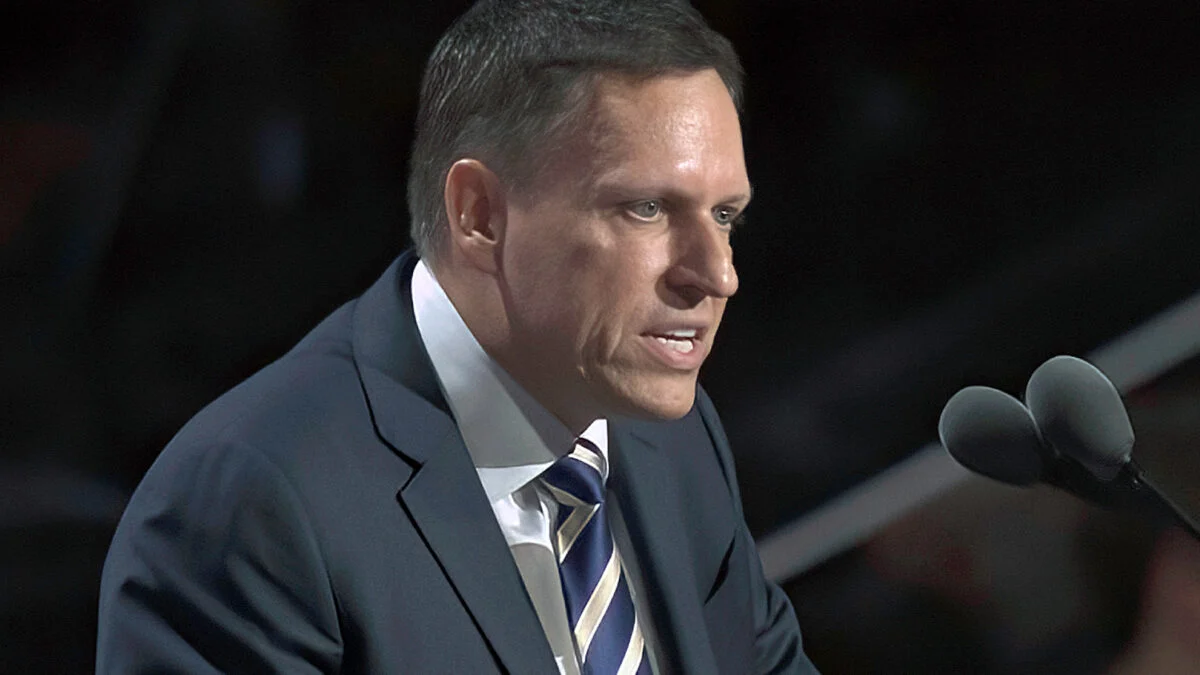
I sat in a Nashville auditorium that smelled faintly of coffee and new seats. You could hear the hush of money—PayPal exits, Founders Fund murmurs—waiting for a sermon that named regulators as villains. Then Peter Thiel stepped up and cast AI-safety advocates as the very thing the Bible warns about.
I want to walk you through what he said and why it matters. I’ll cut to the parts that move the needle: the targets (Barack Obama, the pope), the theology (the Katechon, the antichrist), and the money behind the microphone (Founders Fund, Palantir, Thiel Macro LLC). You’ll get names, dates, and the thin logic holding those claims together so you can decide how worried you should be.
At a $100 (€92) lecture in Nashville, a crowd paid for a sermon about the end times
That’s what Politico reported after obtaining recordings of Thiel’s early events. You weren’t in a church — you were in a ticketed theater, and the speaker was the tech billionaire who helped found PayPal and Palantir.
Thiel framed contemporary AI regulation as political theater. His claim: politicians and moral authorities use AI fear to burnish their popularity. He singled out Barack Obama and the pope, accusing them of weaponizing AI concerns to score political points.
Is Peter Thiel calling AI regulation the antichrist?
Yes and no. Thiel isn’t offering a tidy theological system. He mixes biblical language with political grievance: the antichrist becomes a metaphor for any force that, in his telling, would halt scientific and technological progress. At times he treats the antichrist as an authoritarian ruler; other times it’s a spiritual descriptor for systems that would stop innovation.
In Rome and Paris the same language followed him, and the Vatican did not take it lightly
Thiel’s tour expanded after San Francisco, and his critique of the pope landed hard. The Vatican’s encyclical on AI, warning about “new forms of dehumanization” and “idolatry of profit that sacrifices the weak,” drew Thiel’s ire.
He accused Pope Leo XIV of using AI as a distraction from the church’s child-abuse scandals — a political calculation more than a moral one, in Thiel’s view. Vatican advisors fired back; one asked publicly whether Thiel’s stance bordered on heresy. That exchange is now part of the spectacle.
Why is Thiel attacking the pope over AI?
Thiel sees the pope’s encyclical as political leverage. He argues the church adopted AI as a popular moral issue to regain standing, and he reads that as an institutional pivot that threatens technological progress. Remember: Thiel’s bets and public persona make this a fight between faith-based moral authority and market-driven innovation.
At one lecture, the Katechon and Effective Altruism became stand-ins for a future world government
Thiel spent a large portion of a lecture explaining the Katechon — the restrainer from 2 Thessalonians — and how contemporary ideas might accelerate a totalizing power. He then pivoted to Effective Altruism, saying the movement’s technocratic impulses could feed a one-world authority with the power to halt dangerous science.
He warned that once such a global regulator exists, it would never surrender power. That’s a political fear wrapped in apocalyptic language.
How is Thiel invested in AI?
He has clear skin in the game. Founders Fund and Palantir are part of his influence network, and his hedge fund, Thiel Macro LLC, reportedly holds an AI-focused portfolio valued at $418 million (≈€385 million). That financial footprint is why critics point out a conflict between his public hostility to regulation and private interest in AI growth.
I’ve watched wealthy backers argue policy for years; Thiel’s approach feels different. He trades measured policy analysis for rhetorical extremity, and he wraps it in scripture. He is a preacher at the lip of a cliff.
At the heart of the performance is a repeating pattern: accusation, anecdote, authority-name
Thiel uses three moves. First: he accuses a public figure (Obama, Greta Thunberg, Eliezer Yudkowsky) of either pandering or posing existential risk. Second: he drops a line of scripture or a historical anecdote to lend weight. Third: he invokes his roster of tech wins — PayPal, Founders Fund, Palantir — to signal credibility.
That pattern works because it leverages cultural trust in two places: money and mastery. His investments are a moat around his convictions.
In public reaction, the same anxieties repeat in different language
Journalists at Politico and The Guardian documented the Nashville and San Francisco appearances; pundits pointed out the self-interest. Critics said Thiel’s framing serves Silicon Valley: make regulation seem the enemy, and you clear the path for more capital to flow into AI startups.
Meanwhile, religious thinkers are unnerved by the mixing of apocalypse rhetoric and venture-capital logic. You’re left to ask whether this is a genuine theological challenge or a political stunt dressed in scripture.
There are consequences. If you’re an AI researcher, a policymaker, or a donor, Thiel’s narrative tries to shift the moral frame from harm prevention to freedom to innovate. If you care about governance, his talks aim to make caution look like tyranny. If you follow technology investments, his money signals where power might consolidate next.
I’ve given you the scenes, the players, and the stakes. Now I’ll ask: when a billionaire with PayPal roots and a public portfolio worth $418 million (≈€385 million) argues that regulators are the real antichrist, do you take him as a prophet, a protector of profit, or something more dangerous?