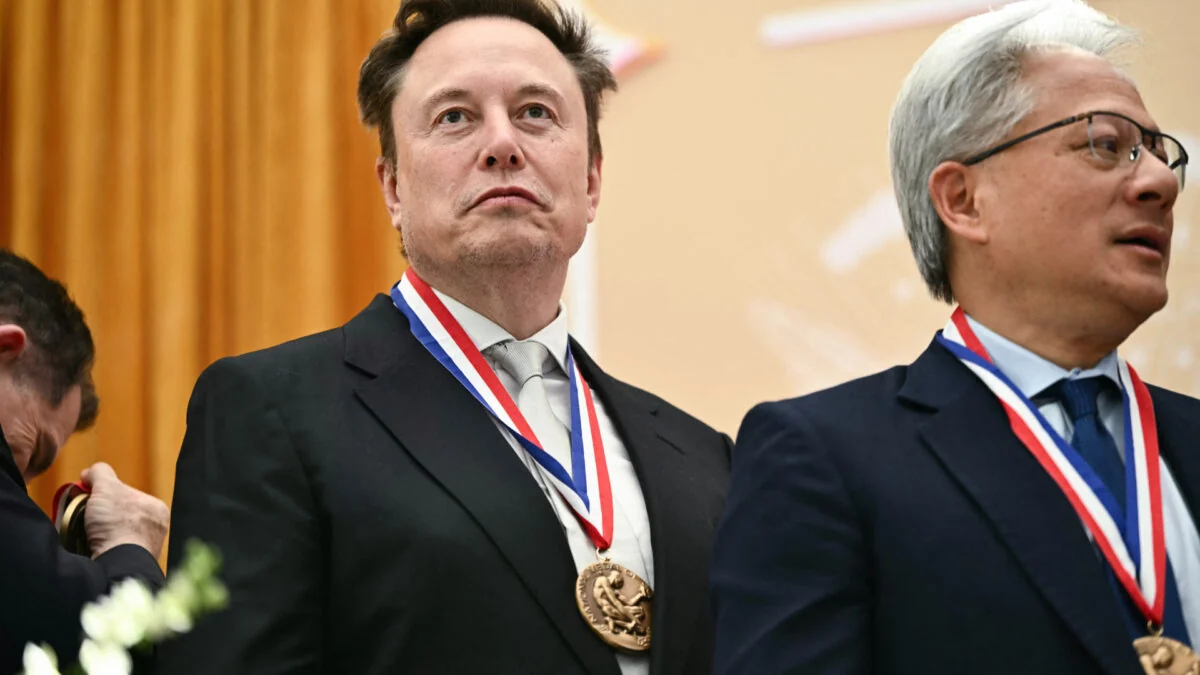
I was scrolling X when Elon Musk dropped three words that made the feed tilt: “That would be an honor.” You felt the air change—this was not a routine compliment. I want you to sit with that for a second.
He didn’t say which company he’d put Jensen Huang into, but the gesture did more than flirt with a hiring rumor. It pulled a thread through a tangle of wealth, power, alleged espionage and corporate tolerance—and you can see how messy the knot gets fast.
That would be an honor
— Elon Musk (@elonmusk) November 12, 2026
On X, a three-word reply landed like a headline. Then the questions multiplied.
I’ve covered executives and their fallouts long enough to smell the theater in a public show of support. You know the script: a magnate tweets, fans cheer, critics sharpen knives, and reporters chase the receipts that don’t want to be found.
Huang isn’t your average ex-CEO. He’s still worth about $150 billion (€140 billion) and faces allegations that look less like marital drama and more like national-security fireworks. The Culper Research report alleges that more than 20% of Nvidia’s fiscal 2026 compute revenue flowed through schemes diverting chips to China. That’s not just gossip; it’s the sort of claim that attracts regulators, auditors, and hedge funds with pens poised.
A boardroom moral failure became a national-security story right after the exit.
When I dug into the reporting—New York Times, Axios, Culper Research—you start to see overlapping circles: an affair with someone allegedly tied to a foreign intelligence network, another affair with a subordinate, and export-control questions. You can argue that personal missteps don’t erase capability, but you can’t pretend the personal and the corporate never touch.
Would Elon Musk hire Jensen Huang?
Short answer: Musk signaled interest and nothing more. Publicly saying you’d be honored to hire someone is a reputational signal to a particular crowd: the billionaires-forgive-everything club. Musk gives himself room to court applause without writing a contract. That’s both strategy and signal management.
In the newsroom, the sentiment split like two tribes.
You’ve probably seen Tech Twitter coalesce in defense of Huang: a “he made a mistake” chorus, and the “moral failing but not business” line. I don’t dismiss the instinct to separate private life from CEO performance. But the nuance here is that the alleged private behavior allegedly intersected with business decisions that may have skirted laws.
Why was Jensen Huang ousted from Nvidia?
Reports say the board moved after the affairs and the spotlight on potential export diversions made Huang a liability. Boards measure risk—legal exposure, investor confidence, regulatory heat—and sometimes wealth can’t shield a CEO when the optics and the allegations threaten shareholder value.
SpaceX’s recent court news shows you where Musk’s tolerance lands in public law.
A federal appeals court ruled that a sexual harassment and retaliation suit by former SpaceX employees can proceed in court instead of arbitration. This case traces to an alleged incident involving Musk and a flight attendant, and shows how actions by a CEO can ripple into company culture and legal consequences.
That ruling undercuts a narrative some elites prefer: that money alone makes accountability optional. Yet Musk remains, in many ways, insulated—his companies still thrive on investor belief. He’s been through WSJ exposés, documentaries, and regulatory scrutiny and kept momentum for Tesla, SpaceX and xAI rolling.
The pattern is obvious: Musk signals support for a peer whose exit raises alarms, and he does it from a position of near-immunity. You can see why some interpret his comment as solidarity, and others as brazenness.
I watched how geopolitical strands got pulled into a Silicon Valley breakup.
Huang publicly pushed for looser chip-sales rules to China, while reports say Musk at times sided with hawks pushing tighter export controls. Yet both men have tangled, differently, with foreign states—Musk with Saudi investments and alleged talks with Russia’s leadership, Huang with ties that critics say merit scrutiny.
When state actors, venture funds, and export rules meet private relationships, the result is messy. It’s like a velvet rope at a nightclub: who you let past it signals power and permission. And sometimes those decisions are about more than loyalty; they’re bets on how much scandal a market will absorb.
Is it illegal to divert chips to China?
Export laws and trade controls make it illegal to funnel restricted technology to sanctioned or blacklisted entities. Allegations in the Culper report, if proven, would expose companies and individuals to serious penalties and investigations by agencies like the Commerce Department and DOJ. That’s why boards don’t treat these claims lightly.
Companies and reputations are fragile in different ways.
SpaceX’s IPO success and Tesla’s market resilience show that investors often put product narratives ahead of moral questions. But regulators and courts don’t follow the same PR path. Your reputation can be patched publicly, yet the cracks remain; sometimes the repairs hold, sometimes they snap. It can feel as if a cracked windshield had been glued back together, and you keep driving until the next pothole exposes the fracture.
Musk’s public embrace of Huang is also a lesson in how billionaire networks work: endorsements, private financing (remember the $3 billion (€2.8 billion) Saudi-linked xAI deal), and shared tolerance for headline friction. These moves remind you that power operates on both optics and private deals.

I will tell you what to watch next: boards, courts, and export filings.
If you follow the filings—SEC disclosures, Commerce Department inquiries, and the coming civil suits—you’ll see which parts of this story are performative and which are legal. I watch sources from the New York Times to Axios to the Wall Street Journal and the specialist reports like Culper because they triangulate what’s noise and what’s evidence.
There are lines that public praise can’t erase: legal exposure, regulatory scrutiny, and a market that eventually prices in risk. You can cheer for a rehabilitation arc; you can argue that skill should outweigh scandal. But you should also ask who pays the bill if the allegations are true—the nation, shareholders, or the employees who tried to raise alarms.
This is not just about two men who sowed wild oats. It’s about how power shelters—or doesn’t—when stakes include national security and billions in trade. Which side will you bet on when the audits finally land?