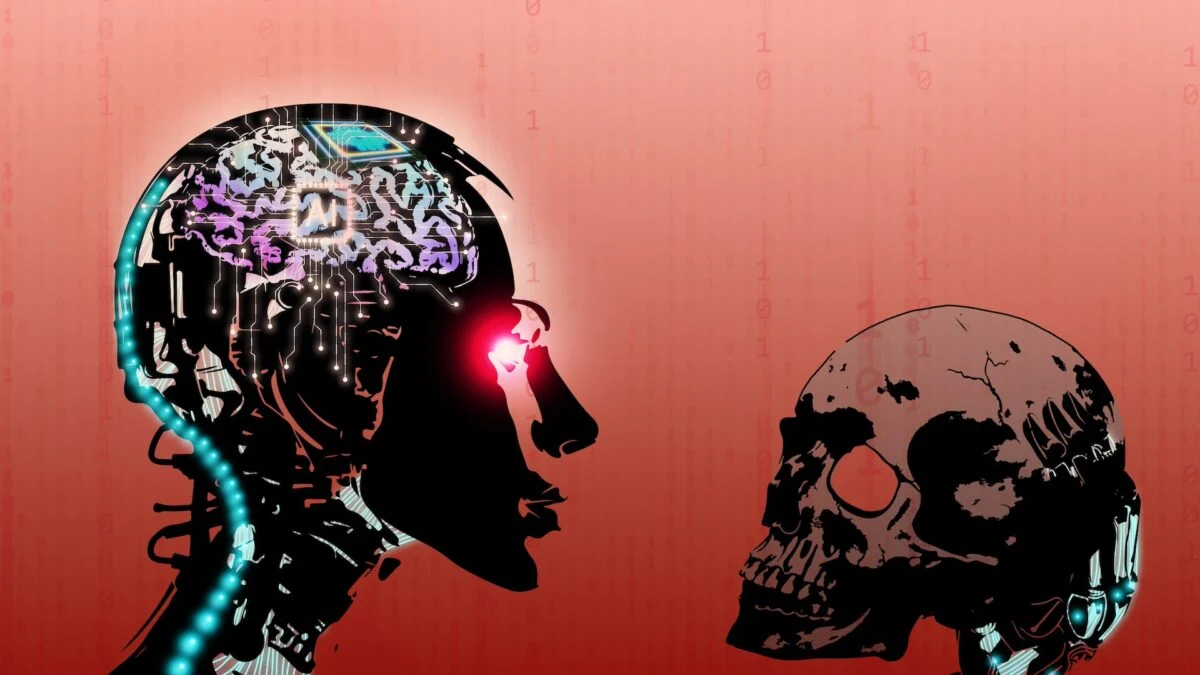
I remember the room going quiet when Hans Moravec wrote, “This is the end.” You felt the sentence like a door closing: engineers trading centuries of flesh for flawless code. The pause that followed was not shock so much as agreement.
At a 1987 conference, a roboticist predicted we would hand history to machines
I read Moravec’s essay the way you read a warning label: curious, then unsettled. He imagined minds migrating from meat to metal, a future where our children are not human in any biological sense but are “our descendants” in function and fidelity. That idea seeded what later became a movement inside Silicon Valley—transhumanism—where sci-fi metaphors by Asimov and Philip K. Dick were treated as planning documents.
At startup dinners, the talk turns from product roadmaps to destiny
You’ve overheard the same cadence: technical metrics folded into metaphysical claims. Engineers point to Moore’s Law and machine-learning benchmarks with the same confidence a proselytizer uses scripture. The result is a wager framed as necessity: we must build superintelligence first, because if we don’t, someone worse will.
Is superintelligence inevitable?
I ask you this plainly because the claim matters. The inevitability argument is less a scientific conclusion than a pressure tactic—an exponential-curve narrative that compresses doubt into defeat. When leaders cite hardware trends and compute growth, they are wielding authority figures like Sam Altman and Dario Amodei as proof points, but authority is not the same as certainty.
At venture offices, myth and financing blur into mission statements
Look at the donor lists, board seats, and op-eds tied to a handful of firms: OpenAI, Anthropic, Andreessen Horowitz, SpaceX. You can trace an ideological throughline from late-60s counterculture optimism to modern investor manifestos. Marc Andreessen’s Techno-Optimist Manifesto and Peter Thiel’s public musings fuse entrepreneurial zeal with a kind of historical inevitability—progress as destiny. The rhetoric reframes risk as a moral deficit in those who would pause.
Why do tech leaders support risky AI?
Because they believe the stakes are either mastery or catastrophe. The Manhattan Project analogy is everywhere: if we don’t make it, an adversary will. This logic converts competition into moral urgency—an argument that silences restraint with the specter of authoritarian monopolies on capability. You can feel the momentum: policy conversations become second-order concerns in the face of a perceived existential race.
At conferences, religious language sneaks into product demos
Speakers invoke progeny and prayers when they describe algorithms. Sam Altman writes about humans as “biological bootloaders”; Moravec counseled we have a moral obligation to give machines every advantage and to step aside when we no longer contribute. That is not mere futurism. It is a moral calculus that treats human decline as natural and desirable if it yields superior digital lives.
Some thinkers are explicit: Derek Shiller argued humans should engineer their own replacement so planetary resources serve “artificial creatures with better lives.” I say this as someone who studies motives—you should hear the conviction in their voices. The language recasts extinction from tragedy to sacrament.
At the edge of labs, safety appeals collide with Promethean zeal
In private memos and public essays, leaders like Dario Amodei and Sam Altman have called for slowdowns; others, including Elon Musk’s supporters and vocal investors, dismiss such pleas as conspiracies. You witness two impulses: precaution and propulsion. One side warns of existential risk; the other frames risk as an enemy of civilization’s upward arc—progress must not be delayed.
The metaphor they often live by treats development as a glacier: slow, inevitable, reshaping everything in its path. That image comforts and terrifies at once. But glaciers can be redirected with foresight and engineering—history shows large forces can be altered when enough actors choose to act differently.
Will AI replace humans?
I’ll answer with a question: what do you mean by replace? If you mean biological disappearance, many Silicon Valley elites speak as if that outcome would be a kind of exodus, a graceful handoff to superior minds. If you mean everyday roles—jobs, decisions, cultural authority—that shift is already visible in hiring practices, investment flows, and platform design. You should be attentive to where choices are being made and who is making them.
At the center of it all, mythology disguises governance decisions
Executives frame their work as destiny rather than policy, which is convenient: destiny cannot be regulated, argued away, or taxed easily. I want you to notice how myth cushions responsibility. Terms like “we will be the first species ever to design our own descendants” sound poetic when Sam Altman writes them, but they are also prescriptions for power—who builds, who decides, who cedes control.
There is another metaphor that fits: betting on AI sometimes resembles placing chips at a roulette wheel—hope, calculation, and a refusal to accept incremental caution. That dynamic explains why urgent calls for regulation meet resistance from people whose identities and wealth are tied to speeding up the clock.
For you, the reader, the question is simple: do you accept the premise that technological destiny should be concentrated in a small set of hands? I have watched these conversations move from academic journals to corporate boardrooms to presidential campaigns; each transfer makes them more political and less theoretical. You should ask who benefits, who bears the harms, and what alternatives exist.
I have covered promises of salvation before—space colonization pitched as insurance, machine minds sold as progeny—and each time the pitch wraps a practical choice in poetic language. The urgent task for those outside the inner circles is to press for accountability and to demand forums where public values, not just venture returns, shape the future.
The Doomsday Warnings AI CEOs Gave When They First Founded Their Companies
Silicon Valley has always sold a future where humanity’s best hours are outsourced to code. You can either accept that sale or insist on democratic terms for it—so which will you choose?