
The screen blinked at 03:14. A Gulfstream that usually sits quiet on the tarmac swung into the sky. You sense a small coldness when patterns break—and that’s exactly where this story starts.
I’m Kyle McDonald-adjacent only in curiosity: I trace odd signals, test what data says, and I want you to see how a public feed of private jets became a doomsday detector. Read this as a short field guide: I’ll point out what matters, what doesn’t, and what to watch for.
A Gulfstream lifts off from Teterboro at dawn — How an artist turned flight logs into a doomsday detector
Kyle McDonald took two public things—the FAA’s aircraft registry and live feeds from ADS-B Exchange—and asked a blunt question: if the world were ending, wouldn’t the people who get the memo first climb into jets and vanish? That premise is simple and chilling.
ADS-B, short for automatic dependent surveillance–broadcast, is the system where planes broadcast position, heading, and identity. The FAA folded it into its NextGen plan and millions of pings are public; ADS-B Exchange aggregates those pings in near real time. McDonald chose a fixed cohort of about 11,000 business jets (the cohort size will wobble with registry updates) and cross-checked who’s airborne.
The site, Apocalypse Early Warning, boils that stream down to an alert level. It compares current airborne counts to a recent baseline for the same hour and day, computes standard deviations, and displays a 0–5+ scale—5 means the count is five or more standard deviations above normal, which the site flags as a likely imminent apocalypse.
Can private jet tracking predict a nuclear attack?
Short answer: it’s a signal, not a sealed prophecy. If an intelligence leak or a credible warning hit the wealthy first, mass departures of bizjets would register as an outlier. But false positives are real: air shows, charter demand spikes, or coordinated repositioning can mimic panic. You should treat the tracker like an alarm bell—you investigate the bell’s origin rather than assume the building is on fire.
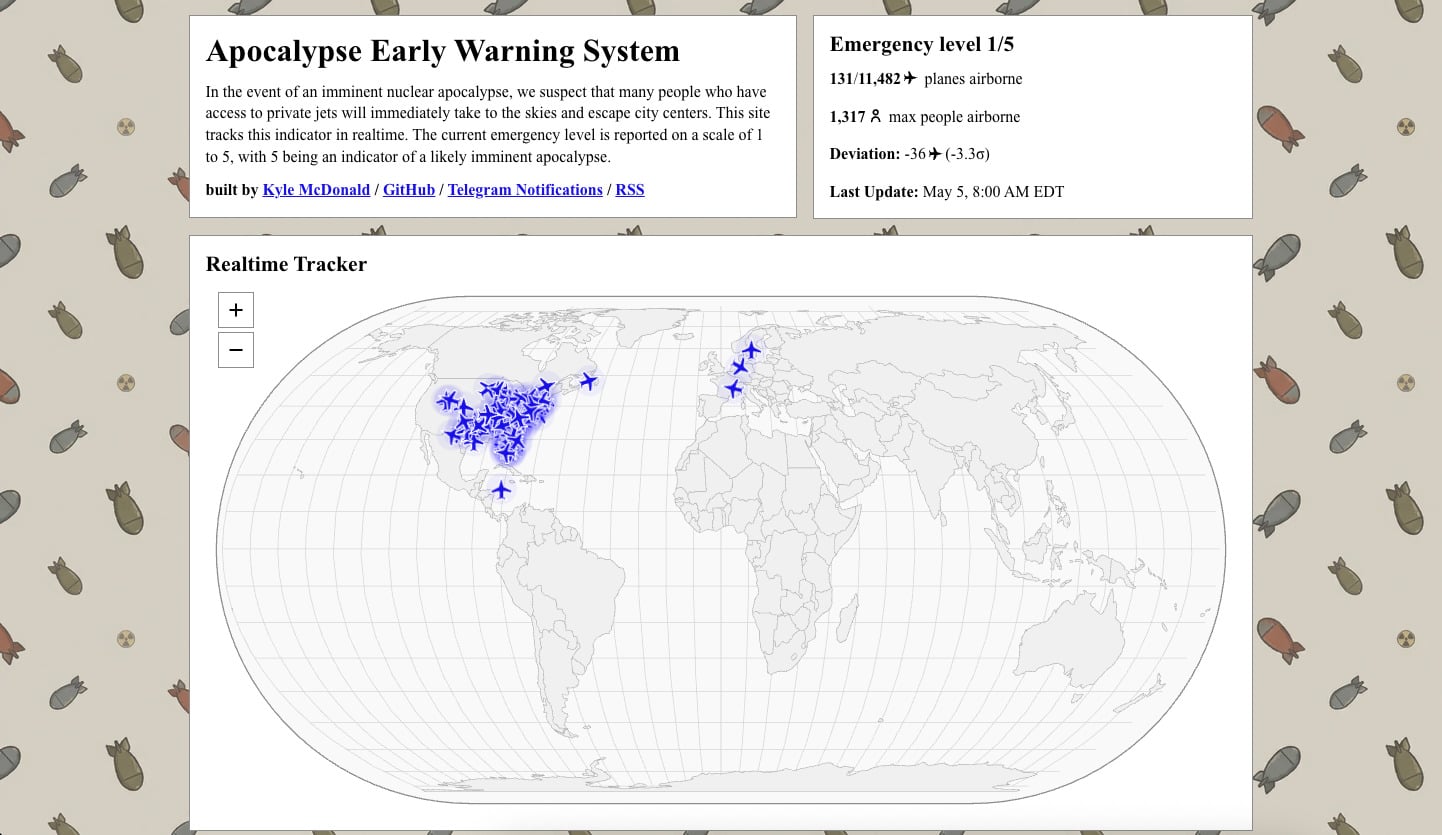
At 07:00 local time dozens of business jets climbed — How the math decides whether the world is ending
I checked an early-morning spike and watched the baseline refuse to budge until a cluster of departures nudged it hard. The site measures departure counts against a rolling recent baseline for the same hour and weekday, then reports how many standard deviations away today’s count sits.
Standard deviations are just a way to say how weird a number is compared with recent routine. One or two sigmas is noise; five sigmas is rare. When the counter hits five, McDonald’s site labels it “an indicator of a likely imminent apocalypse.” The headline is designed to shock—and that shock is the tool: it forces you to ask what else is happening in the world right now.
How does ADS-B tracking work?
Planes equipped with ADS-B transmit position via GPS to anyone with a receiver. ADS-B Exchange collects those transmissions from volunteers and feeders worldwide. That public stream is the raw material—name, tail number, altitude, heading—used to count business jets aloft at any moment.
If you were tempted to profit from a spike—say, placing a bet on a prediction market like Polymarket—know this: bets are denominated in USD and stablecoins commonly used on those platforms. A $100 (≈€93) wager might be tempting as a hedge, but the signal’s noise makes for risky speculation. I’d rather track corroborating signals—media reports, official advisories, and travel advisories—before I touch my wallet.
The alert system is elegant in its simplicity: public registry + public ADS-B feed + statistical baseline = a single number that claims to summarize existential risk. It reads like a warning light on an instrument panel; you still need to check the gauges before ejecting.
The FAA lists ADS-B as part of NextGen — What this means for privacy, policy, and profit
I read the FAA’s materials and the current Senate bill S.2175 that would put limits on ADS-B data use for fees and tracking. The technology was meant for traffic control and safety, but public availability creates a second life for the data: research, journalism, and, yes, DIY eschatology.
That second life attracts scrutiny. Airports and FBOs worry about landing-fee analytics; privacy advocates worry about tracking wealthy people’s movements. Congress is talking about what companies can do with the feed. None of that bans McDonald’s experiment yet; it sits in a gray policy zone that could harden into law.
Is tracking private jets legal?
Generally yes: ADS-B broadcasts are public by design, and aggregators operate in open-source and commercial spaces. But legal constraints can rise—if regulators decide certain uses constitute harassment, stalking, or commercial misuse, laws and rules will follow. Right now the data is public, and experiments like McDonald’s are legal provocations more than illicit surveillance.
I’ll tell you plainly: this project works because public systems leak social priorities. When the wealthy move as a group, it reveals information—about risk, about rumor, about who gets the early memo. The site turns that revelation into a single, shareable number. That number is dramatic by design, and drama draws attention.
One metaphor: the tracker is like a weather map for panic—colors and spikes tell you where wind is picking up even if you can’t see the clouds yet. Another: it’s a blinking lighthouse in a fog of data, warning and ambiguous at the same time.
You can treat the alert as a curiosity, a tool, or a market signal; you can also treat it as a mirror showing who holds information and how they react. So: when the jets light up on the screen, do you sprint for the bunker, call your senator, hedge your bets for $100 (≈€93), or sit tight and wait for confirmation—what would you do?