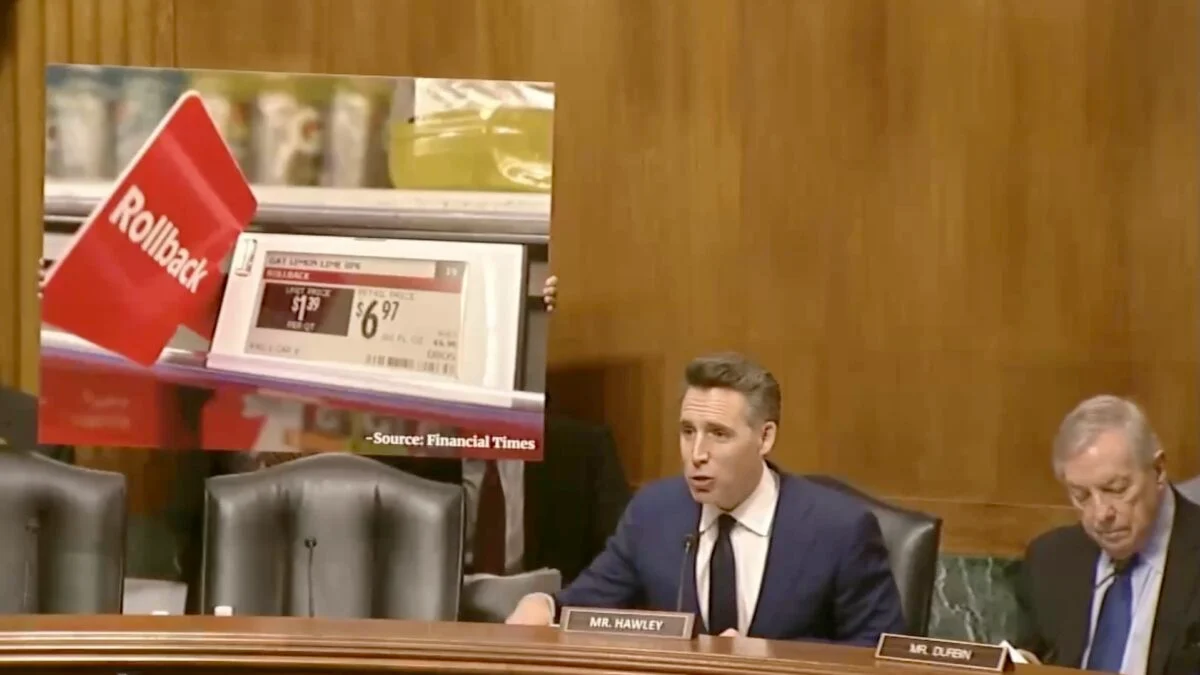
I was in the hearing room when a senator stopped mid-question and looked at the screen as if he’d seen a side of retail he hadn’t suspected. You could feel the room contracting—party lines softened, pens paused, cameras tilted. For a few minutes, outrage had a bipartisan shape.
I’ll walk you through what happened, why it matters to your wallet, and where the real leverage lives — and I’ll be blunt: this isn’t just theory. You already pay the price whether you notice it or not.
Senators from both parties paused and read the testimony out loud.
That quiet was the most revealing moment. Josh Hawley opened by naming Staples, Target, Lyft and Amazon, and called the practice “one of the biggest scams in American history.” Dick Durbin, the committee’s ranking Democrat, nodded along until he said he had little to add. When both sides are handing the floor to experts, you know the political theater is moving toward something more serious.
Lindsay Owens of Groundwork Collaborative became the hearing’s gravity. She described companies cataloging your location, your purchases, even cursor movements to set prices. Her testimony landed because it turned an abstract tech problem into a personal one: your data turned into a pricing experiment. It was a mirror held up to corporate behavior, and you could see where it reflected back on your bank balance.
What is surveillance pricing?
Surveillance pricing — often rebranded by industry as personalized pricing — is the practice of using personal data and algorithms to charge different customers different amounts for the same good or service. Companies say it rewards loyalty and tightens competition. Critics say it’s targeted extraction wrapped in convenience.
I watched industry representatives defend the practice with careful language.
They prefer “personalized pricing” and point to loyalty discounts and student or senior rates as evidence that price differentiation is consumer-friendly. John Zhang of Wharton argued that information is essential to “really get to know the consumers.”
But the gap between what they call personalization and what customers experience is wide. Loyalty programs and targeted coupons can feel like savings, yet they also supply the raw material for models that test where your willingness to pay breaks. That pressure builds like a pressure cooker — the consumer benefits claimed are often the slow release valve, not the reason the system exists.
How does AI surveillance pricing affect consumers?
In practice you can win a discount one day and be nudged to pay more the next. Algorithms use browsing history, location data, membership status, and even micro-behaviors to estimate the maximum price you’ll accept. For many shoppers this means hidden increases, not personalized bargains.
An aisle of state laws now lines the map.
Maryland, Connecticut, New Jersey and New York have all moved to limit surveillance pricing in specific contexts, and Colorado’s legislature passed a law that was later vetoed by Governor Jared Polis. Activists cheered Maryland’s grocery-store ban, but criticized its loopholes. The patchwork approach leaves consumers protected in some places and exposed in others.
Kroger’s numbers landed like a punchline in the hearing: the company reported roughly $500 million (€460 million) from selling customer data. Polling shared at the hearing showed 68% of Americans fear surveillance pricing will raise costs; only 5% think it will lower prices.
Can Congress stop surveillance pricing?
Both the House and Senate have introduced narrowly tailored bills, but neither has advanced. On paper, federal regulation would help consumers and clash with entrenched corporate incentives — a combination that usually means gridlock. You can read the room as I did: cameras flash, statements are filed, but legislative change is an uphill climb.
I’ve watched hearings before that felt decisive and others that were performative. This one had sincerity from both sides and a roster of witnesses — Hawkins-style fire, Groundwork’s data, Wharton’s defense — that made the policy stakes visible. The question now is whether lawmakers will convert outrage into rules that stop companies from treating people as price experiments.
You care about this because the bill for targeted pricing lands in your cart and your monthly statements; if Congress doesn’t act, the patchwork of state bans will be the thin shield between your family’s budget and corporate price optimization — so who will press for change next?