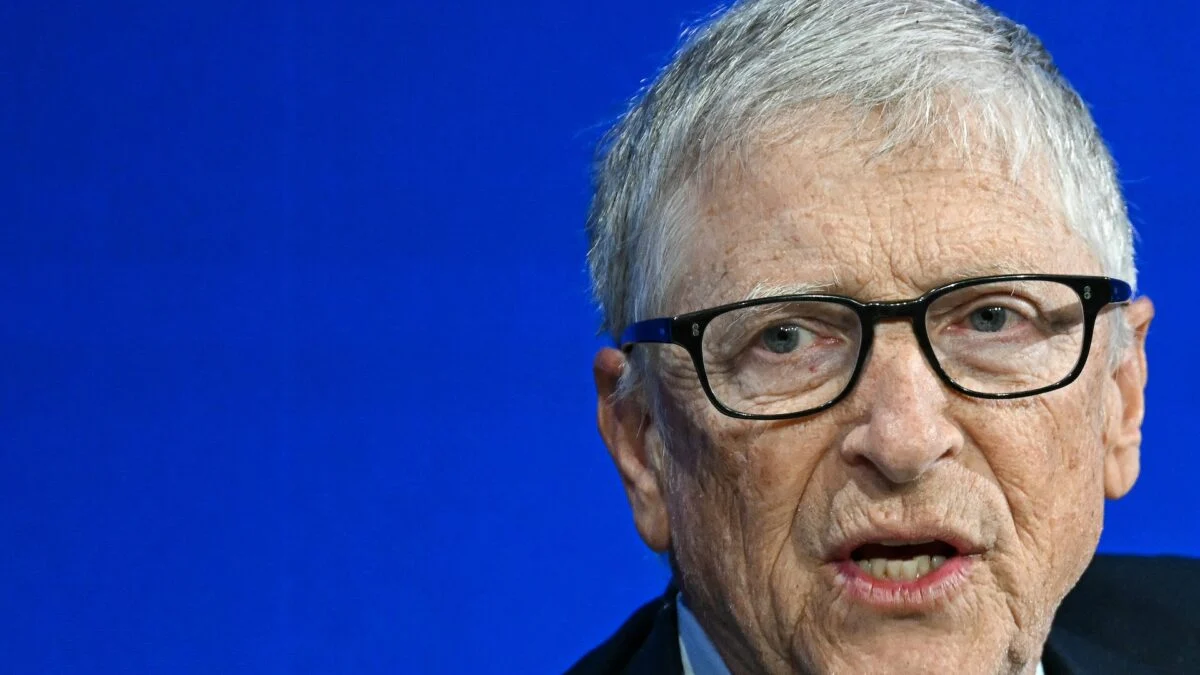
I was watching Bill Gates on a studio couch — calm, precise, a man who helped build the software scaffolding of modern life — say something that made the room feel small. He looked straight at the camera and warned that AI could “drive events that, you know, cause a billion deaths.” You could feel the pause after the sentence, the kind that asks you to decide whether to act or wait.
I’ll say this plainly: you and I are sitting on the edge of a decision that will be remembered. I write from a place of curiosity and hard questions, not alarm for alarm’s sake. You’ll get the facts, the thread of influence, and what Gates thinks his role should be.
At a TV studio on Sunday morning, Gates told millions he wants to speak with Trump about AI — and not casually.
On Meet the Press, Gates pushed one message: law enforcement and politicians must join the conversation about what safeguards and monitoring look like. “You need law enforcement and the politicians to get into the discussion about what safeguards and monitoring look like,” he said, adding, “No one thinks self-regulation is enough.”
I believe his pitch to President Donald Trump is tactical. Gates knows how influence flows in Washington: private conversations between heavy hitters can change priorities. He told the host he hoped his own voice — as a founder of Microsoft and a long-time player in global health and philanthropy — would add weight to what Trump already hears.
Will Bill Gates meet Trump to discuss AI regulation?
Gates has precedent. He met Trump in August 2025 to argue against deep cuts to U.S. global health funding. That effort didn’t stop the administration from pursuing reductions, but it shows Gates will sit in the same room and make a case. If you ask whether such a meeting will happen again, the answer today is: plausible, and strategic. Gates wants to be heard not as an alarmist but as someone who helped build the technology and now warns of its misuse.
At the center of Gates’s warning is a recognition that AI power has shifted hands.
For years, Gates praised AI’s promise; more recently, he’s emphasized its potential for harm. He wrote an essay in August 2026 urging fast action to avoid what he called “the most turbulent times in human history.” That’s not rhetorical flourishes — it’s a recalibration from booster to gatekeeper.
Consider the actors: Microsoft, led by Satya Nadella, is partnered with OpenAI, where Sam Altman has led rapid model development. OpenAI’s recent pause on advanced development — announced the same weekend reporters flagged security incidents — is a rare public admission that the pace of deployment invites risk. Security firms like SentinelOne and researchers such as Juan Andrés Guerrero-Saade have been blunt: apocalyptic scenarios can be overblown, but present-day harms — cyberattacks, disinformation, manipulation of vulnerable people — are real and growing.
Gates’s language matters. He didn’t lean on Hollywood metaphors of rogue robots; he said plainly that the combination of malicious people and advanced tools could be unmatched in history. It’s a sober metaphor — like a loaded gun in a playground — and it puts the choice on the human actors, not on fate.
Can AI actually cause a billion deaths?
Gates’s phrasing grabbed headlines, but experts parse probability versus possibility. No public demonstration has shown an AI-generated plague is imminent. Still, the core concern is realistic: sophisticated tools lower friction for harm. I want you to hold two facts at once: the worst-case claim is extreme, and the trajectory of certain capabilities makes new, plausible harms easier. That duality is why policymakers are finally being dragged into the debate.
At the intersection of policy and philanthropy, past alliances shape credibility and risk.
Gates’s standing is complicated. You don’t get to be the public face of technology and global health without messy history. His old ties to Jeffrey Epstein have kept him in the headlines, and they have narrowed his social capital — even long-time allies have pulled back.
That reality matters because influence is personal. Gates believes his past achievements and current alarm give him a special lane to talk to Trump. But politics is mercenary: facts and moral authority travel differently in the West Wing than in a lab or a foundation office.
There’s also money at stake. The Trump administration has pursued cuts to foreign aid and global health programs — moves that analysts say amount to roughly $30 billion (~€28 billion) in reduced health funding through 2030, and efforts to divert about $3 billion (~€2.8 billion) of global health dollars to other priorities. Those shifts show how policy choices about one kind of global risk — disease and poverty — can be repurposed into choices about another — technology governance.
At a tactical level, what should you watch next?
Gates is asking for laws and enforcement; he’s not conceding that industry self-regulation will be enough. If you follow the players — Microsoft, OpenAI, Sam Altman, Satya Nadella — you’ll see a pattern: labs pushing capability, governments catching up. Sometimes labs push back, sometimes they pause public work. The recent OpenAI pause is the kind of friction that can produce policy windows.
If I were advising you on signals, watch for: presidential meetings, draft legislation, agency guidance, and private councils like OpenAI’s Frontier Risk Council. Those are the levers that turn fear into rules or into inaction. Think of the system like a city during a brewing storm; if the sirens don’t sound early, the choices get binary and ugly.
I won’t flatter you with easy answers. My read is this: Gates’s offer to be an envoy to Trump is smart, ego-edged, and possibly necessary. He brings credibility and a frank voice, and he knows how to stitch NGO, corporate, and government conversations together. If you want the debate to move from headlines to enforceable standards, those stitched conversations have to happen now.
So I’ll leave you with this: will we let a few late-night warnings and private meetings decide the architecture of AI safety, or will you demand clearer rules now that the people who built the tools are pleading for them?