I was in a cramped GameStop in Queens when a clerk stacked a fresh PS5 beside a pile of trade-ins and said, “Those sell fast.” You could feel the room shift—brand momentum has a weight of its own. That small, ordinary moment explains why American gamers still tilt toward PlayStation.
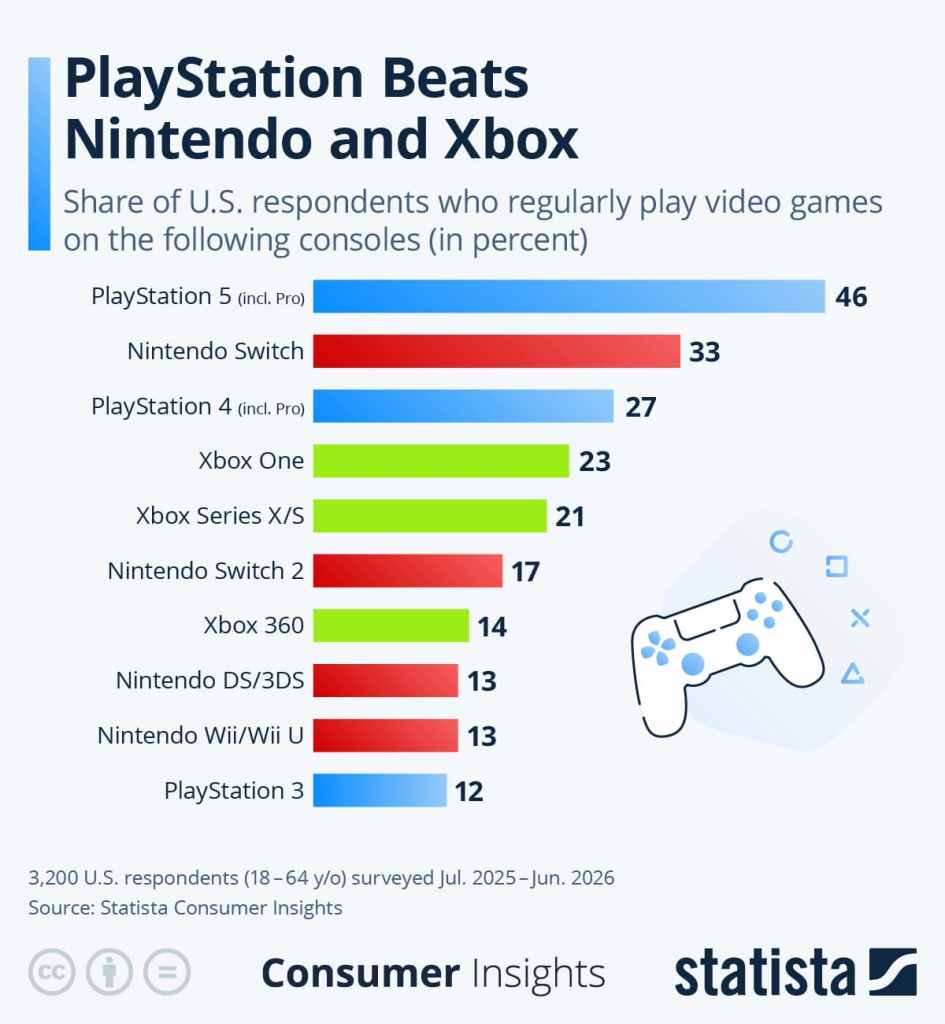
I checked the numbers. Statista Consumer Insights polled 3,200 U.S. adults aged 18–64 between July 2025 and June 2026 and found a clear lead: 46% of regular players report using a PS5 or PS5 Pro, 27% play on PS4, and 12% still fire up PS3. Nintendo remains strong — 33% on Switch and 17% on Switch 2 — while Xbox spreads across generations: 23% on Xbox One, 21% on Series X|S, and 14% on Xbox 360.
I stood behind a line at a Black Friday-like restock — PlayStation still commands household attention
The PS5’s share reads like a headline: Sony’s platform is the one most people choose when they say they “regularly play.” You and I both know this isn’t only about raw hardware specs; it’s a blend of brand memory, exclusive titles (hello, PlayStation Studios), storefronts like the PlayStation Store, and the resale ecosystem at places such as GameStop.
Think of PlayStation as a flagship store on the busiest avenue: people pass by, remember it, and come back. The PS5’s retail price remains an anchor for many buyers — the standard disc PS5 lists around $499 (≈€455), which frames purchasing decisions across consoles and accessories.
Why is PlayStation more popular than Xbox?
Because Sony has layered recognition across generations. You can trace loyalty from PS2 nostalgia to PS5 hype; exclusive narratives, developer relationships, and the PlayStation brand identity keep players coming back. Microsoft counters with Game Pass and cloud play, and those services are powerful, but the study shows service strength hasn’t yet toppled Sony’s installed base for “regular” play.
A friend pulled an old Wii U from his attic — legacy hardware still hums
Older consoles aren’t relics; people still play them. The numbers prove it: PS3, Xbox 360 and older Nintendo systems show up in active playlists in 2026. You probably know someone who won’t let go of a comfort game.
This persistence is less mysterious when you consider libraries and secondhand value. Backwards compatibility, digital storefronts, and the thrift of buying used discs or cartridges keep last-gen machines relevant. It’s like an old radio that still plays your favorite song: familiarity and access matter more than novelty for a lot of players.
Do people still play older consoles?
Yes. A surprising slice of respondents report regular play on consoles several generations back. That’s a reminder that “regular player” isn’t a synonym for “latest hardware owner.” Economic pressures, collector habits, and specific game libraries all preserve older machines.
I saw PS5 bundles sell out online within hours — what the study signals about where the market may go
Short sellouts and steady demand push a narrative about future consoles. If the PS5 base is this large, Sony has leverage: platform decisions, PlayStation Plus packages, and the shape of exclusives will matter to millions. Critics will watch the company’s moves—like the debate around ending physical discs—for signs that players will change allegiance.
Is PS5 the best console to buy?
“Best” depends on what you value. If you want exclusive single-player narratives and a massive install base, PS5 is attractive. If you prize subscription value and backward compatibility, Xbox with Game Pass or a Nintendo Switch variant may suit you better. The Statista data suggests many Americans pick PlayStation when their choice comes down to regular play.
I’m not pretending the Statista pool of 3,200 represents every US gamer, but it’s a strong signal. You can read this as brand inertia, as the pull of exclusive games, or as simple social proof: where your friends and local stores point, many players follow. Platforms named in the study—Sony, Nintendo, Microsoft—and data sources like Statista and outlets such as Moyens I/O shape how we interpret those trends.
So where does that leave us? Sony’s decisions—on discs, services, and future hardware like a potential PS6—will be tested against an installed base that currently favors PlayStation. Will a change in physical media or a misstep in content strategy dent that lead?